Interior Painting in Naperville, IL
Bathroom painting in Naperville with paint that stands up to steam
Peeling above the shower, mildew in the corners or a bathroom still in builder beige? Bathrooms need prep and paint made for steam, and that is how we paint them.
We answer 24/7 and book walk-throughs on the first call.
Answering 24/7Naperville service office
Updated September 2026
This job
Bathroom Painting
Interior Painting · answering 24/7
Quick answer
Bathroom painting in Naperville, IL uses a moisture- and mildew-resistant paint over cleaned, repaired and primed surfaces, usually satin on walls and a moisture-resistant flat on the ceiling. A typical bathroom is a one- to two-day job, depending on repairs and drying time.
The job
Bathrooms fail paint faster than any other room
Steam condenses on cool walls and ceilings, soap and hairspray film the surface, and mildew grows in corners the fan does not clear. Ordinary wall paint blisters and peels there.
We clean off film and mildew, scrape and patch peeling areas, recaulk split joints, prime and paint two coats of a moisture-resistant finish. The fan gets checked while we are there, since a weak fan is behind most bathroom paint failures.
What moves the price
What bathroom painting costs
A bathroom is a small room, but prep and moisture repairs set most of the price.
- 01Room size and ceiling
Wall and ceiling area set paint and labor.
- 02Peeling and mildew
Scraping, cleaning and mildew treatment add time.
- 03Drywall damage
Soft or water-damaged drywall is repaired first.
- 04Trim and doors
Door, window and base trim add enamel work.
- 05Tile edges and fixtures
Cutting cleanly around tile, mirrors and fixtures takes care.
- 06Color change
Dark to light usually adds a coat.
Published cost data for small interior painting and staining projects (HomeAdvisor Chicago-suburb project cost data, September 2026): $300 to $1,375 typical. A planning range, not our quote.
What this job covers
A
Moisture-resistant wall painting
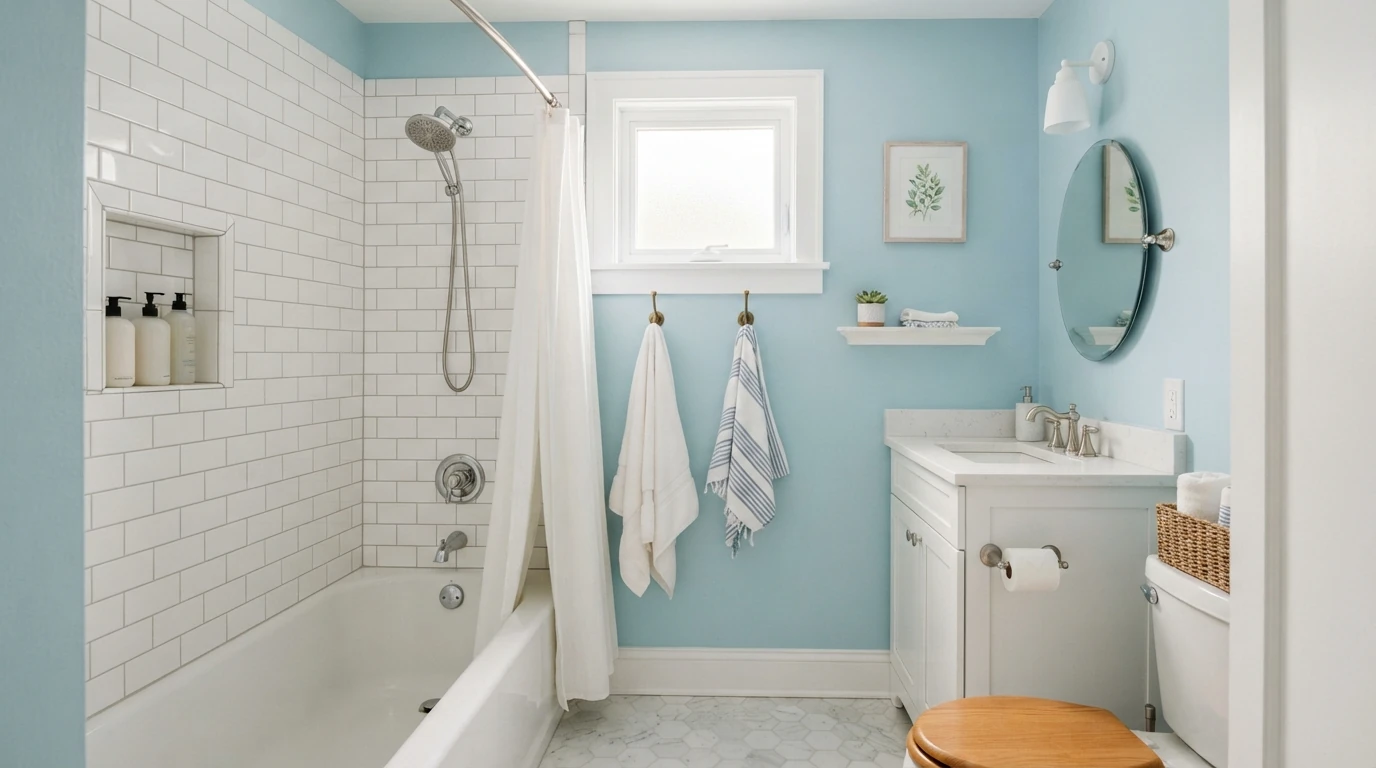
Bathroom walls get a paint made for humidity, usually in satin, which resists moisture and cleans easily. Before it goes on, the walls are washed to remove soap and hairspray film, glossy areas are sanded, and any patches are primed. We cut in carefully along tile, tub and vanity edges and around mirrors and fixtures, and apply two full coats. The room then needs to stay dry, with the shower unused, for about a day while the paint cures and hardens.
B
Mildew cleanup and sealing
Gray or black spots in corners and on the ceiling above the shower are mildew, and painting over it without cleaning only hides it for a few weeks. We clean it with a mildew wash, rinse and let the surface dry, then seal the stains with a stain-blocking primer before the finish coats. Split caulk around the tub, shower and sink is cut out and replaced with a mildew-resistant caulk. If mildew keeps returning from behind tile, we point that out rather than painting over it.
C
Bathroom ceiling and trim
Bathroom ceilings take the most steam, so peeling usually starts there, often in a ring around the shower. We scrape loose paint to a firm edge, skim and sand the edges flat, prime and paint the ceiling with a moisture-resistant flat. Door and window trim and the baseboard behind the toilet get a hard enamel that wipes clean. Doors are painted on both faces and the bottom edge, which is often left bare and swells in the humidity if it is skipped.
What is included
What a bathroom paint job should include
- Walls washed to remove soap and hairspray film
- Mildew cleaned and stains sealed
- Peeling paint scraped and edges skimmed flat
- Split caulk replaced with mildew-resistant caulk
- Primer on patches and stains
- Two coats of moisture-resistant paint
- Trim and doors in a wipeable enamel
- A check of the exhaust fan while we are there
Around Naperville
Bathrooms here deal with two seasons of trouble: humid summers, when walls barely dry between showers, and furnace-dry winters, when cold outside walls collect condensation. Both push moisture into the paint film. That is why every bathroom we paint gets a moisture-resistant product, why we check that the exhaust fan actually moves air, and why families are asked to keep the shower off for about a day after the last coat.
How the job runs
How a bathroom job runs
- Step 1
Walk-through
We check peeling, mildew, caulk and the fan, and agree on colors.
- Step 2
Protect
Tile, tub, vanity and floor are covered and fixtures masked.
- Step 3
Clean and repair
Film and mildew come off, peeling is scraped and patches made.
- Step 4
Prime and caulk
Stains and patches are primed; split caulk is replaced.
- Step 5
Two coats
Walls, ceiling and trim get two coats of moisture-resistant paint.
- Step 6
Cure
The room is left ventilated and we say when the shower can be used.
Bathroom paints and primers we use come from Benjamin Moore, Sherwin-Williams and Zinsser.
Benjamin Moore, Sherwin-Williams, JC Licht, Behr, PPG, Valspar, Cabot, Sikkens, Rust-Oleum, Zinsser, Purdy, Wooster
A moisture- and mildew-resistant paint, usually satin on walls and a moisture-resistant flat on the ceiling.
Steam condenses there. Weak ventilation, soap film and ordinary paint make it worse.
Not until it is cleaned and sealed. Paint over mildew lets it come back through.
Usually about a day, while the paint cures.
Yes, with a moisture-resistant flat after peeling is scraped and the edges skimmed.
Often booked together
Other jobs that usually come up alongside this one
Fire & Smoke Damage Repainting
Soot and smoke stain sealing
See the jobInterior House Painting
Single-room painting
See the jobTrim, Door & Baseboard Painting
Baseboard and casing
See the jobPre-Sale Home Painting
Neutral repaints before listing
See the jobDecorative Wall Finishes
Limewash and Roman clay walls
See the jobAnswering now
Book a bathroom painting visit in Naperville
Call any hour. We check the walls, ceiling and fan, and send a written estimate.
