Cabinets & Prep in Naperville, IL
Garage floor epoxy coating in Naperville, prepped by grinding, not just washing
Stained, dusty or salt-pitted garage floor? We grind the concrete, fix the cracks and lay an epoxy system that stands up to hot tires, road salt and spills.
We answer 24/7 and book walk-throughs on the first call.
Answering 24/7Naperville service office
Updated September 2026
This job
Garage Floor Epoxy Coating
Cabinets & Prep · answering 24/7
Quick answer
Garage floor epoxy in Naperville, IL means diamond-grinding the concrete, repairing cracks and pits, then applying a primer, a pigmented epoxy coat and a clear topcoat, with or without decorative flakes. Grinding matters most, because epoxy on a smooth or oily slab peels under hot tires.
The job
Most failed garage coatings failed at the prep
A kit rolled onto washed concrete sits on the surface, and hot tires lift it within a year. Grinding opens the concrete so the epoxy bonds into it instead of onto it.
We test for moisture and old sealers, grind the whole slab, fill cracks and pits, and apply a multi-coat system, with a slip-resistant texture in the topcoat if you want one.
What moves the price
What moves the price of an epoxy floor
Epoxy floors are priced by square footage and the condition of the slab.
- 01Floor size
Square footage of the garage or basement sets material and labor.
- 02Slab condition
Cracks, pits, spalling and old coatings add grinding and repair.
- 03System choice
Solid color, partial flake and full flake differ in material.
- 04Topcoat
Clear topcoats vary in cost and in how they resist UV and scratches.
- 05Moisture
Damp slabs may need a moisture-mitigating primer.
- 06Extras
Stem walls, steps and stair treads add detail work.
What this job covers
A
Solid-color epoxy
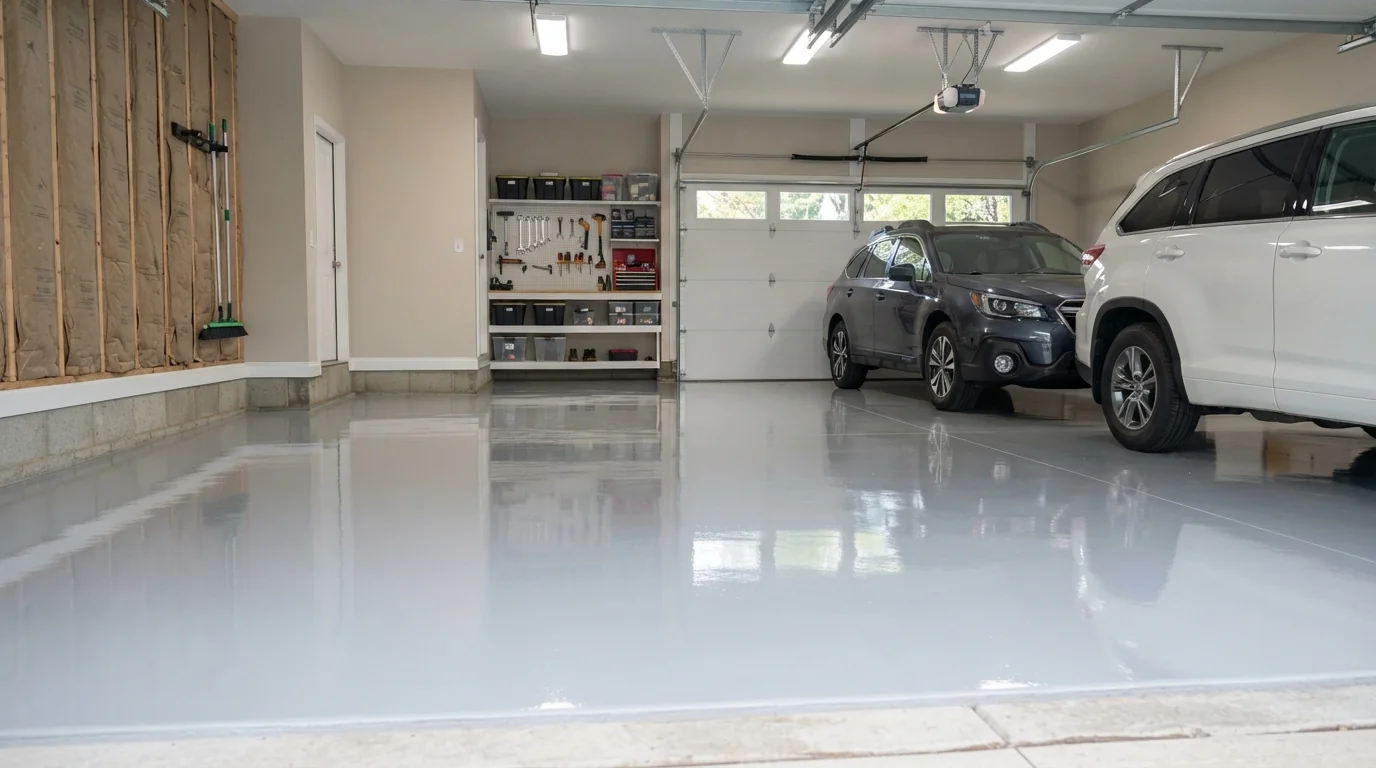
A solid-color system is a primer, a pigmented epoxy body coat and a clear topcoat in one color, usually gray, tan or white. It gives a clean, bright floor that is easy to sweep and mop, and it makes a garage feel far lighter than bare concrete does. We add a fine anti-slip grit to the topcoat so the floor is not slick when wet. Solid color shows tire marks and dust more than a flake floor, which is the main trade-off to weigh.
B
Flake and chip systems
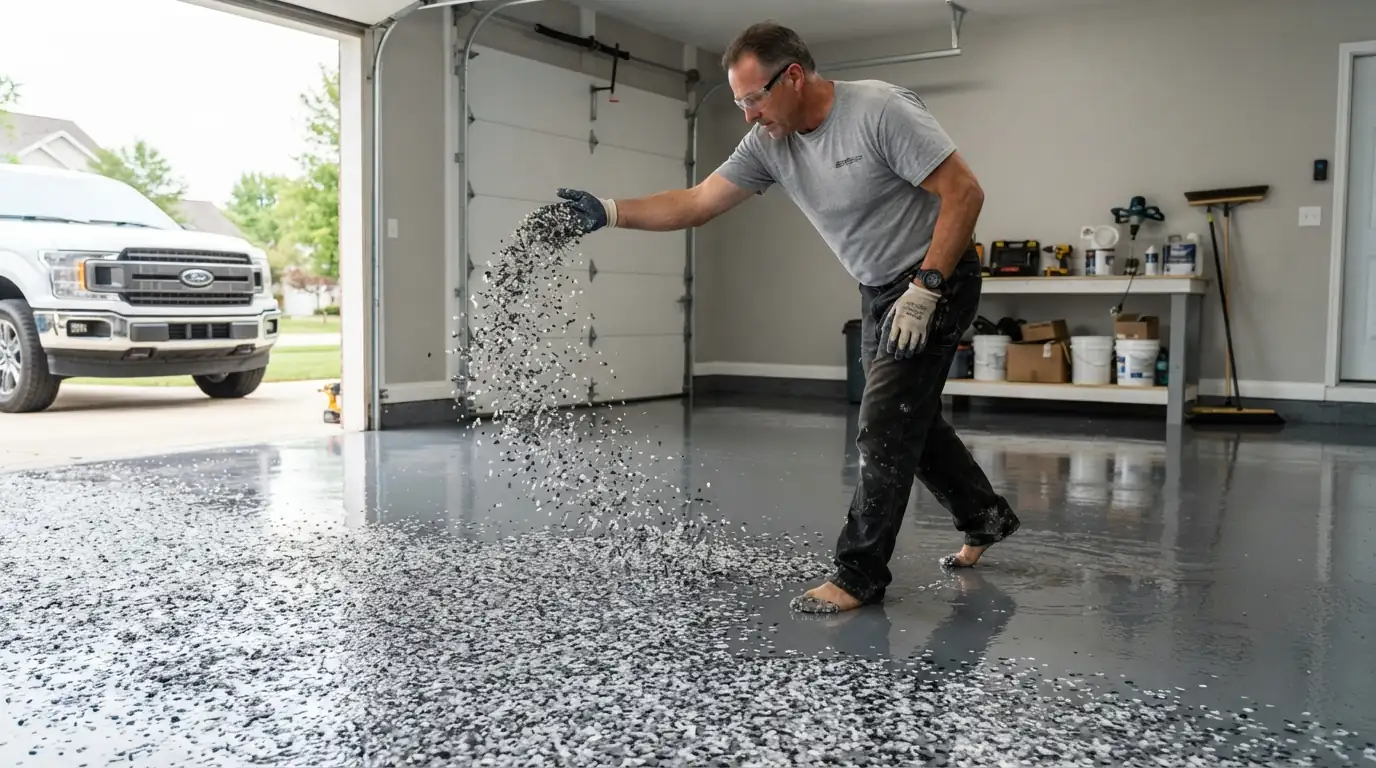
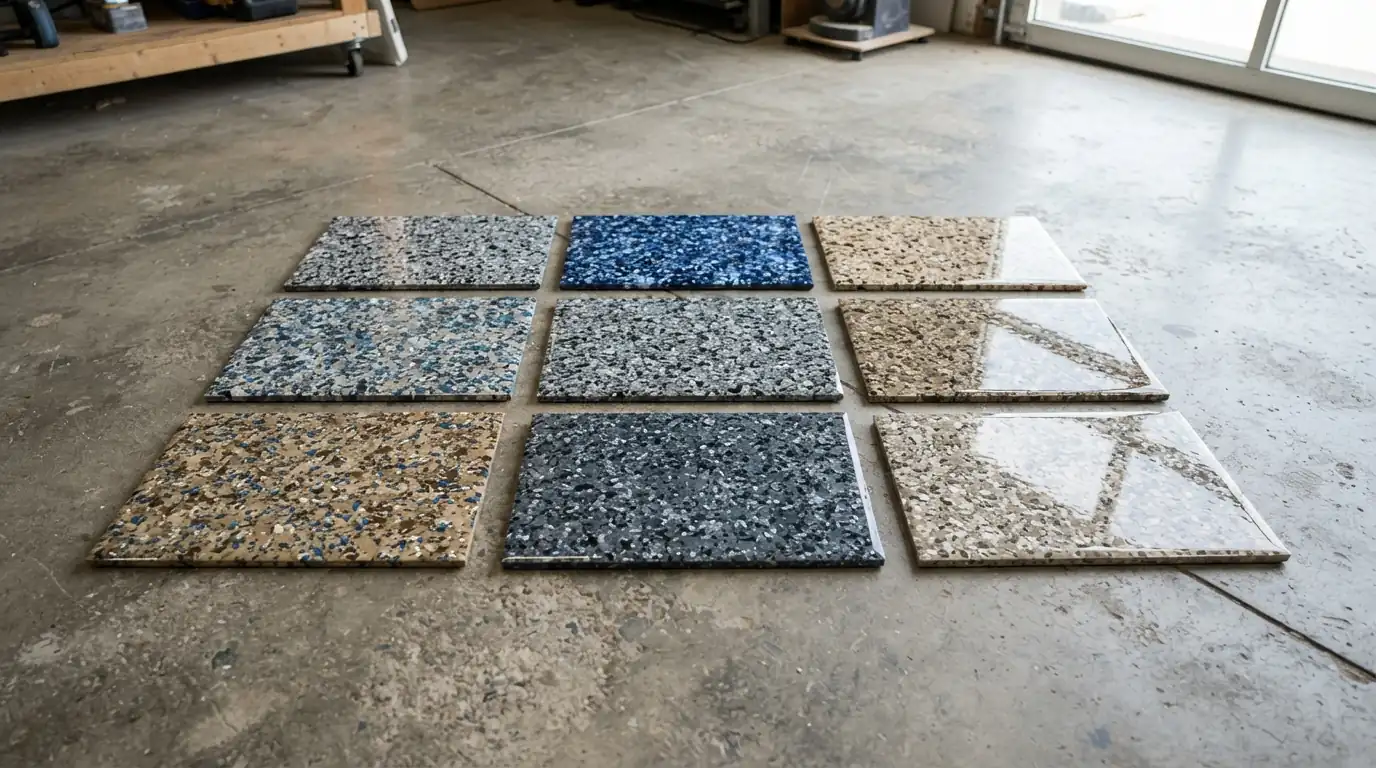
Flake floors broadcast colored vinyl chips into the wet base coat until the surface is fully covered, then the loose chips are scraped off and the floor is sealed under a clear topcoat. The flakes hide dust, tire marks and small flaws in the slab, and they add texture underfoot. Full-broadcast flake is the most common choice for a two- or three-car garage. You pick a flake blend from samples, and the base color is matched to it so any gaps never show.
C
Basement and workshop floors
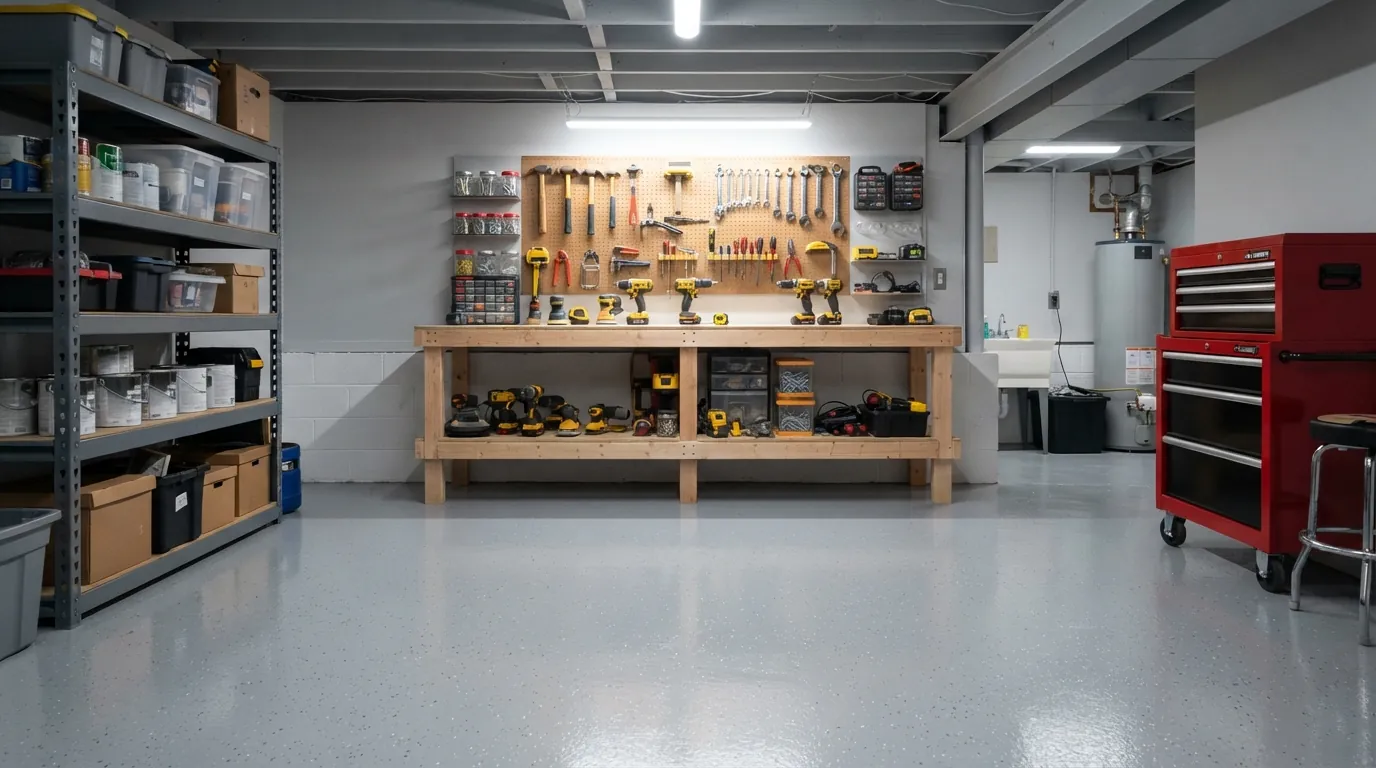
Basement floors and workshops can take the same systems, with one extra check: moisture coming up through the slab. We test before quoting, because a coating over a damp slab can blister. Workshops often get a solid color with a thicker build for dropped tools, while basements used as rec rooms or gyms often get flake. Floor drains are kept open, and we work around water heaters and furnaces rather than coating under them. A moisture-tolerant primer is used where the test calls for it.
Compare the options
Epoxy, flake or floor paint?
All three cover concrete. They last very differently under cars.
| Item | Solid epoxy | Epoxy with flake | Garage floor paint |
|---|---|---|---|
| Prep | Diamond grinding | Diamond grinding | Wash and etch |
| Hides dust and marks | Somewhat | Very well | Poorly |
| Hot-tire lift | Resists when bonded | Resists when bonded | Common within a year or two |
| Relative cost | Middle | Highest | Lowest |
Around Naperville
Chicago-area normals give January about 27 sub-freezing days and put November's average high at just 49F, and that matters twice for a garage floor here. Winter tires carry road salt in, which pits bare concrete and eats cheap floor paint. And epoxy needs a warm slab to cure, so unheated Naperville garages are best coated between spring and early fall, when a 68F May or 63F October day gives the coating a proper cure.
How the job runs
How an epoxy floor job runs
- Step 1
Walk-through
We measure, test for moisture and old sealers, and show samples.
- Step 2
Clear and protect
The garage is emptied and walls are masked near the floor.
- Step 3
Grind
The slab is diamond-ground and vacuumed to open the surface.
- Step 4
Repair
Cracks, pits and spalls are filled and ground flush.
- Step 5
Coat
Primer, pigmented base coat, flakes if chosen, then a clear topcoat.
- Step 6
Cure and walk
We tell you when to walk and when to park, and check it with you.
Timing
How long the garage is out of use
Most garage floors take two to three days: grinding and repairs first, then the coats. The floor is walkable about a day after the last coat, and cars usually wait several more days until the topcoat has cured. Epoxy needs the slab and air warm enough to cure, so we schedule it from spring through early fall, or in a heated garage.
Floor coatings and primers we apply come from Sherwin-Williams, Rust-Oleum and PPG.
Benjamin Moore, Sherwin-Williams, JC Licht, Behr, PPG, Valspar, Cabot, Sikkens, Rust-Oleum, Zinsser, Purdy, Wooster
Many years when it is properly bonded. Most failures come from poor prep, not the epoxy itself.
The old coating is ground off first. Epoxy over paint or sealer lifts along with it.
Usually several days after the last coat, depending on temperature. We give you the date for your floor.
It can be when wet, so we add an anti-slip grit to the topcoat if you want it.
A cured epoxy floor resists salt far better than bare concrete; rinse it off in winter to keep it looking good.
Often booked together
Other jobs that usually come up alongside this one
Answering now
Book a garage floor look in Naperville
Call any hour. We measure the floor, test the slab and send a written estimate for the system you pick.
